Section 1. Introduction to radio direction finding
Transmitter hunting (also known has fox hunting) is a popular activity among amateur radio
enthusiasts wherein participants use
radio direction finding techniques to locate one or more radio transmitters hidden with a designated
search area. Instead of writing a big introduction to Fox Hunting here,
please consult the following links to familiarize yourself with this activity:
Section 2. Your engineering design mission
Your mission is to design a first-iteration prototype of an RF sniffer (VHF direction finding receiver) for finding
the direction of beacons or hidden transmitters. The RF sniffer is really a spectrum analyzer in
disguise.
It measures the amount of RF power at its input port at the frequency of interest within the system's bandwidth
(it ultimately accomplishes this by converting a received radio signal to DC and measuring it).
When a directional antenna is connected to the RF sniffer, you can use this to determine the location of a
beacon.
Your proposed implementation is to meet the general product specifications and requirements specified in
the following section (Section 3).
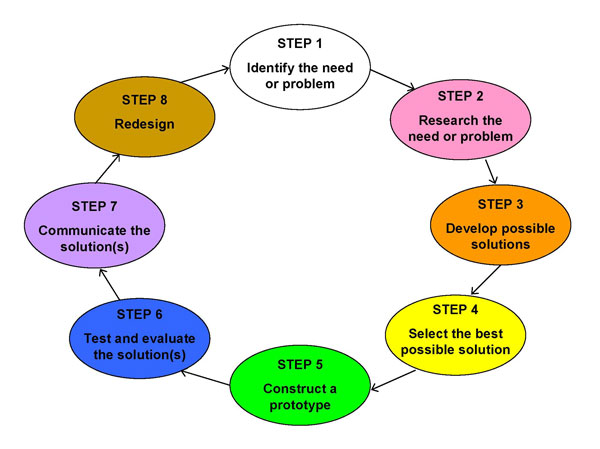
Of course, the real design process involves many steps and is a creative, nonlinear endeavor.
However, for reference, an overly-simplified design procedure is shown in the figure below.
Referring to this figure, you are going to work on Steps 2 - 4 and design a prototype (on "paper")
with a reasonable amount of detail and supporting analysis.
Due to time limitations, you will not actually be constructing or testing the prototype, nor will
you be purchasing any components.
Section 4. What to turn in
You will be creating a PowerPoint presentation, saving it as a PDF, and uploading it Blackboard.
This PDF is your hardware/software design document, which outlines your proposed implementation along
with supporting details and analysis.
Your design document should include the following information:
- Clear, well-labeled block diagram(s) of your system, along with description of receiver architecture.
- Description of user interface and experience.
- Detailed electrical schematics of your entire system.
- Tabulated materials list indicating all components and IC's, along with their prices, and vendor.
- Each major IC in your system should have at least one slide dedicated to it. This slide should
outline all relevant specs and performance of the chip, based upon the component's datasheet. For example, if you
have a low noise amplifier (LNA) IC in your system, you would want a slide that presents the following component
paramers at the frequency bandwidth of interest: power gain, VSWR, noise figure,
power supply requirements (DC current draw), input/output 1 dB compression point, power efficiency, and input/output IP3. Also include
the package type, vendor, manufacturer, and any other special/useful/interesting information (e.g. does it have a disable/enable pin?, etc.).
- Does your system include an embedded system (e.g. a microcontroller, microprocessor, etc.?) If so, describe
the role of your embedded system. Present a flowchart to explain the operation and tasks of the software/firmware.
- How would you logically go about testing and confirming your design? Would you build everything on a single PCB at once for testing?
Would you purchase and use evaluation boards to test major blocks?
What specific RF test and measurement equipment would need to test your design?
Present your test plan and the estimated total cost for testing.
- Present best estimates of the following receiver performance parameters:
- Battery run-time
- Max RF input power (before damage)
- Noise figure
- IP3
- Dynamic range
- Image rejection characteristics
- Frequency coverage
- Bandwidth
- Present the following details regarding the physical circuit layout plan:
- If you were to actually design the physical layout for a PCB, what design software would you use?
- Estimate the size of your physical PCB
- What board material would you use?
- What PCB board house would you use for your prototype? Estimate the cost of building your PCB prototype.